

Introduction to the structure of the vapor chamber
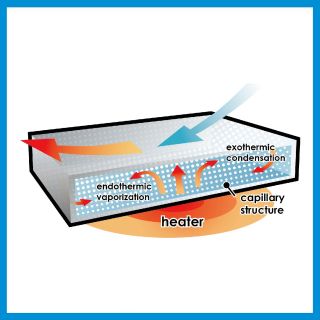
A vapor chamber is a vacuum chamber with microstructured walls designed to facilitate efficient heat transfer. When heat is transferred from the heat source to the evaporation zone, the working fluid inside vaporizes in the liquid phase within a low-vacuum environment. During this process, the working fluid absorbs heat and expands rapidly, filling the chamber in its vapor phase.
As the vapor comes into contact with a cooler area, condensation occurs, releasing the heat accumulated during evaporation. The condensed working fluid is then returned to the evaporative heat source by capillary action within the chamber’s microstructure. This continuous cycle of evaporation and condensation enables the vapor chamber to efficiently manage thermal conductivity and heat dissipation.
A vapor chamber operates independently of gravity due to the capillary forces generated by the microstructure during the evaporation of the working fluid. The theory behind a vapor chamber is similar to that of a heat pipe, but while a heat pipe relies on one-dimensional heat conduction, a vapor chamber offers two-dimensional heat conduction, resulting in significantly greater heat conduction capacity compared to a heat pipe.
This makes vapor chambers highly efficient for thermal management and heat dissipation, providing enhanced performance in applications requiring large surface area cooling, even in gravity-insensitive environments.