

Heat transfer principle of heat pipes
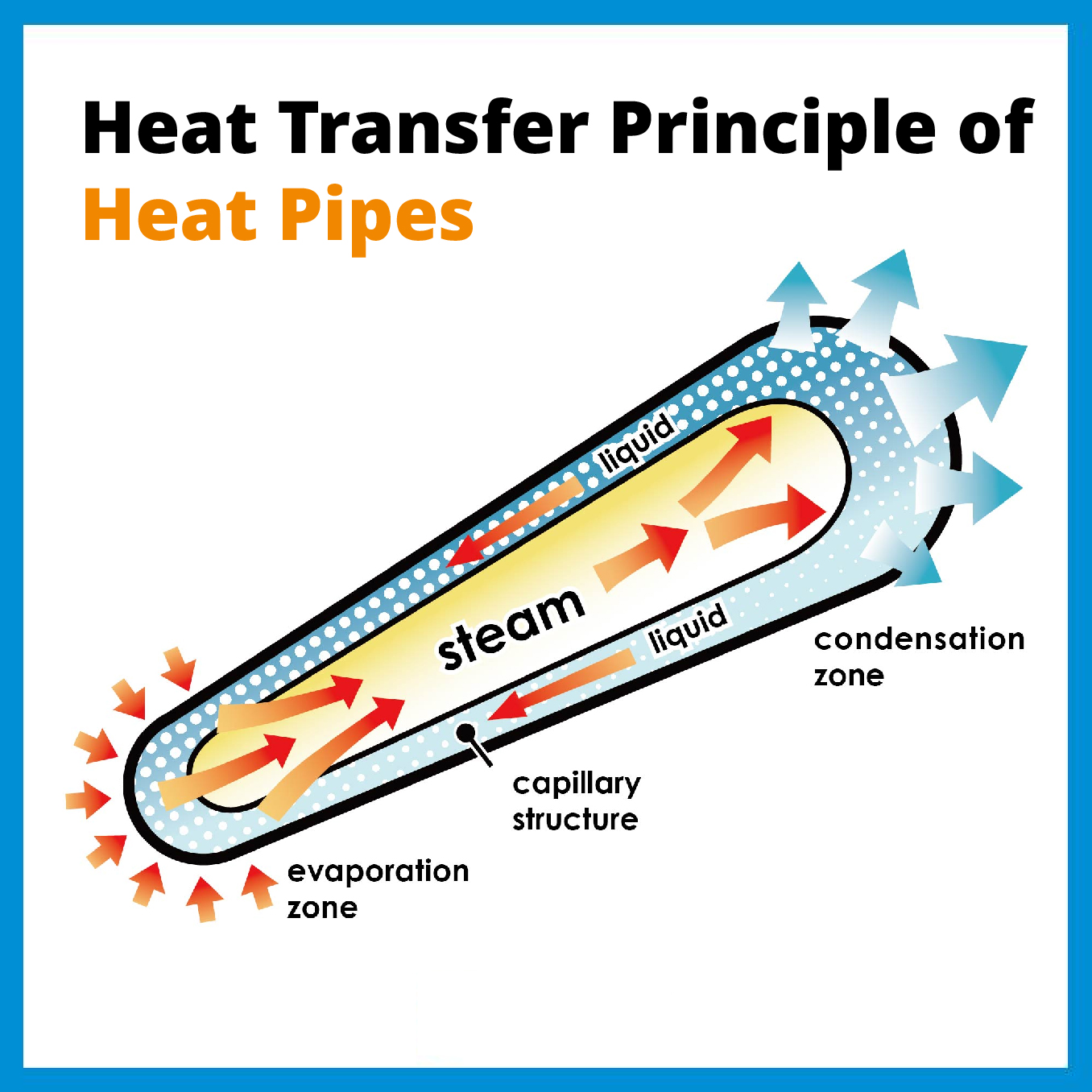
The heat pipe process starts by removing the internal air, then injecting the working fluid, and sealing the pipe. Under low pressure, the vaporization temperature of the working fluid significantly drops. In the vaporization zone, heat is absorbed, causing rapid vaporization. The vapor moves toward the condensing zone, where it releases heat to the external environment and condenses back into a liquid. This liquid returns to the vaporization zone through gravity, capillary force, or the pressure difference within the pipe, creating a continuous heat transfer cycle.
Due to this two-phase fluid flow, the heat transfer coefficient is approximately 50-100 times higher than that of pure aluminum. Heat pipes offer fast temperature uniformity, function as passive elements without requiring electrical energy to drive mechanisms like fans, and are also lightweight, making them an efficient solution for heat dissipation.